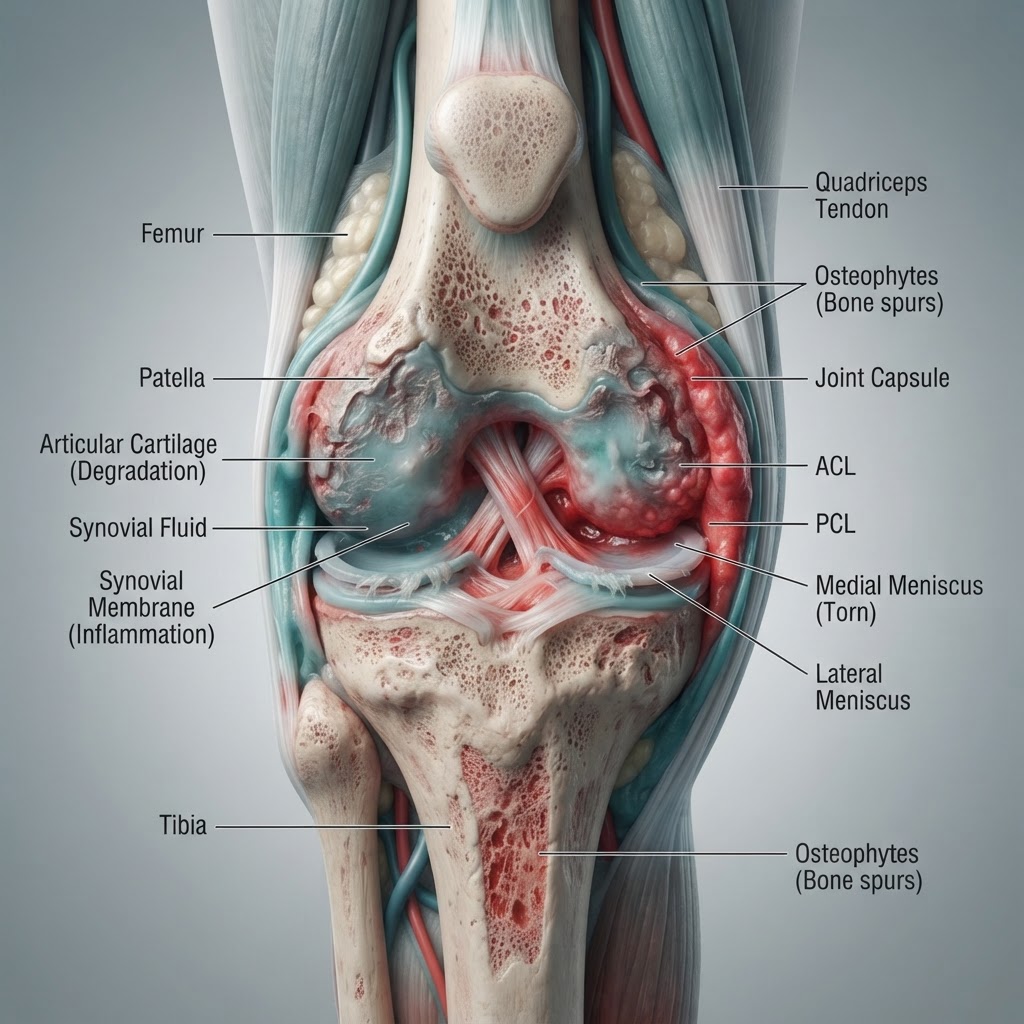
Joint & Connective Tissue Disease
Arthritis & the Infectious Connection
Conventional rheumatology treats arthritis as an autoimmune problem to suppress. Growing evidence — from Lyme arthritis to Chlamydia-induced reactive arthritis — shows many forms of joint disease are triggered or sustained by infection, and that doxycycline can modify the disease itself.
Clinical Insight
For a subset of inflammatory arthritis, the trigger is infection — and the answer is not just immune suppression, but identifying and treating the organism, plus doxycycline's direct cartilage-protective action.
Rule Out Infection First
Has infection actually been ruled out?
Joint pain that migrates, flares unpredictably, or doesn't respond to standard arthritis treatment can be a sign of Lyme disease, not primary arthritis. Most autoimmune and inflammatory joint conditions have never actually had infection ruled out — and the tests most doctors' offices rely on, standard Western blot and PCR testing, often aren't sensitive enough to catch it.
At Newport Integrative, we use next-generation sequencing and comprehensive tick-borne panels to check for Lyme and coinfections before you commit to a long-term arthritis diagnosis and treatment plan.
The Infectious Cause
When a microbe is behind the joint pain
Lyme Arthritis
Borrelia burgdorferi bacteria enter joint tissue — most often the knee — and trigger persistent inflammation. It is the most common late manifestation of Lyme disease and is directly treated with doxycycline. Johns Hopkins data shows Lyme patients have 3.76× the risk of developing inflammatory arthritis.
Reactive Arthritis
A sterile inflammatory arthritis that follows a GI or genitourinary infection. Recognized triggers include Chlamydia trachomatis, Salmonella, Shigella, Yersinia, Campylobacter, and Ureaplasma. Persistent microbial antigens remain in synovial tissue, sustaining joint inflammation long after the initial infection.
Rheumatoid & Undifferentiated Arthritis
A growing body of research suggests some "autoimmune" arthritis is initiated or perpetuated by occult infection. Doxycycline combination therapy has shown benefit in rheumatoid arthritis and undifferentiated spondyloarthropathy — not only as an antibiotic, but as a matrix metalloproteinase (MMP) inhibitor that protects cartilage.
Identifying the infectious driver requires going beyond standard panels. We use advanced diagnostics — including tick-borne testing, next-generation sequencing (NGS), and PCR of synovial fluid — to detect organisms conventional workups miss.
Why Doxycycline?
More than an antibiotic — a disease-modifying agent
Doxycycline does double duty in arthritis. As an antibiotic it targets infection-triggered joint disease — from Lyme arthritis to Chlamydia-induced reactive arthritis. But its independent, non-antibiotic action is what makes it uniquely valuable.
Doxycycline is a potent inhibitor of the matrix metalloproteinases (MMPs) — the collagen-cleaving enzymes (MMP-1, MMP-8, MMP-13) that degrade articular cartilage. By suppressing MMPs, doxycycline slows the structural destruction of the joint itself.
Inhibits cartilage-degrading MMPs
Reduces MMP-13 and MMP-8 collagenase activity by 50–60%, directly slowing cartilage breakdown (Smith et al., 1999).
Quells joint inflammation
Lowers IL-1α, IL-1β, and IL-6 while raising protective TGF-β in osteoarthritic chondrocytes (Shlopov et al., 2001).
Treats the infectious trigger
Effective against Lyme arthritis and, in combination with rifampin, superior in Chlamydia-induced reactive arthritis (Carter et al., 2004).
Disease-modifying, not just symptomatic
Addresses both the microbial driver and the tissue destruction — unlike immune suppressants that only dampen inflammation.
Peer-Reviewed Evidence
Scholarly journals & research
Selected peer-reviewed publications supporting the infectious etiology of arthritis and doxycycline's disease-modifying role.
Smith GN Jr, Mickler EA, Hasty KA, Brandt KD. Specificity of inhibition of matrix metalloproteinase activity by doxycycline: Relationship to structure of the enzyme. Arthritis & Rheumatism. 1999;42(6):1140–1146.
Doxycycline inhibited MMP-13 and MMP-8 (the collagenases that destroy articular cartilage) by 50–60% at 30 μM, while inhibiting MMP-1 by only 18% — establishing doxycycline as a selective, disease-modifying MMP inhibitor in arthritis.
View SourceShlopov BV, Stuart JM, Gumanovskaya ML, Hasty KA. Regulation of cartilage collagenase by doxycycline. Journal of Rheumatology. 2001;28:835–842.
In human osteoarthritic chondrocytes, doxycycline dramatically boosted protective TGF-β while lowering the inflammatory cytokines IL-1α, IL-1β, and IL-6, and suppressing MMP-1 and MMP-13 — reducing cartilage breakdown at the cellular level.
View SourceCarter JD, Valeriano J, Vasey FB. Doxycycline versus doxycycline and rifampin in undifferentiated spondyloarthropathy, with special reference to chlamydia-induced arthritis. A prospective, randomized 9-month comparison. Journal of Rheumatology. 2004;31(10):1973–1980.
The combination of doxycycline and rifampin was superior to doxycycline alone in reducing morning stiffness and swollen/tender joints in patients with Chlamydia-induced reactive arthritis — direct evidence that an antibiotic regimen can improve an infection-triggered arthropathy.
View SourceCarter JD, Hudson AP. The evolving story of Chlamydia-induced reactive arthritis. Current Opinion in Rheumatology. 2010;22(4):424–430.
Reviews the accumulating evidence that persistent Chlamydia antigens and nucleic acids remain in synovial tissue, driving chronic reactive arthritis — supporting an infectious etiology for a subset of inflammatory arthritis.
View SourceLyme Arthritis. In: StatPearls [Internet]. National Center for Biotechnology Information (NCBI), PMC9533683.
Lyme arthritis is caused by Borrelia burgdorferi bacteria entering joint tissue and triggering persistent inflammation; it is a well-documented example of a directly infection-driven arthritis, commonly treated with doxycycline.
View SourceReactive Arthritis. In: StatPearls [Internet]. National Center for Biotechnology Information (NCBI), NBK499831.
Reactive arthritis is a sterile inflammatory joint response following gastrointestinal or genitourinary infection (Chlamydia trachomatis, Salmonella, Shigella, Yersinia, Campylobacter, Ureaplasma, and others) — a clear infectious cause of inflammatory arthritis.
View SourceStrle K, et al. Increased Risk of Autoimmune Inflammatory Arthritis After Acute Lyme Disease. Johns Hopkins Lyme Disease Research Center.
After adjustment for age and sex, Lyme disease patients had 3.76 times the risk of developing inflammatory arthritis, with most cases arising shortly after infection — linking an infectious trigger to later autoimmune arthritis.
View SourceIbrahem EM, et al. Efficacy of doxycycline as a combination therapy in the treatment of rheumatoid arthritis. BMC Rheumatology. 2021.
Doxycycline demonstrated powerful MMP-inhibitory activity and suppressed vascular smooth muscle cell migration, supporting its role as an anti-inflammatory, disease-modifying adjunct in rheumatoid arthritis combination therapy.
View SourceFAQ